
Finding your Visual Voice: Moving beyond Imitation
In our last post, we discussed the power of a series to create cohesive work. But what truly makes a series – or any of your work – unmistakably yours? This is the quest for your visual voice: that unique combination of mark-making, colour sense, and subject matter that allows someone to recognise your work across a room, even before they see the signature.
Your voice is not something you invent overnight. It’s something you uncover through practice, play, and a lot of honest reflection. It’s the difference between speaking the language of art and speaking in your own dialect.
Why Imitation is a Stage, not a Destination
We all start by learning from others. Copying masterworks or the style of an artist you admire is a fantastic way to learn technique. But if you stay there, you become a cover band. Your voice emerges when you start to answer this question: “What do I do differently, almost instinctively, even when I’m trying to copy?”
The Pathways to Your Voice
- Audit Your Heroes: List three – five artists you deeply admire. Now, analyse them coldly. What do they actually do? Is it their graphic line? Their chaotic colour? Their serene emptiness? Write it down. Then, look at your own work. Which of these elements do you naturally gravitate toward? That’s a clue.
- Embrace Your Quirks: Do you always paint skies too dark? Do you obsessively add texture? Do you hate leaving smooth areas? Instead of correcting these “flaws” to match a textbook standard, lean into them. Make the dark skies dramatic. Make the texture your signature. Your quirks are your fingerprints.
- Follow the Joy, Not the ‘Should’: What part of the process do you lose yourself in? Is it laying down the initial drawing? Mixing the perfect, muted grey? The final, frenetic detailing? The subjects you paint for fun, not for practice, are telling you something. Your voice lives in what you do with joy and ease.
Practical Exercise: The Thematic Trio
To move from theory to practice, try this:
- Choose one simple subject (e.g. a cup, a houseplant, a self-portrait).
- Now, paint/draw it three times, but each time, you must deliberately exaggerate a different element:
- Version 1: Exaggerate COLOUR. Make it wild, unnatural, emotional.
- Version 2: Exaggerate LINE. Make it sketchy, graphic, or use only line.
- Version 3: Exaggerate TEXTURE. Build it up, scratch into it, make it tactile.
Which version felt most natural? Which result excited you the most? The answers point toward a core component of your voice.
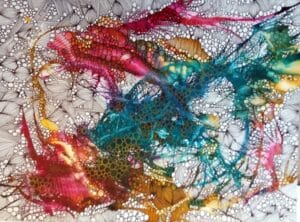
Finding your voice is a lifelong conversation with your work. It’s not about finding one style and sticking to it forever. It’s about developing a coherent thread – a sensibility – that runs through everything you make, whether it’s a serene circle or something whimsical. Pay attention, be brave, and trust that what makes your work different is precisely what will make it connect.
I am often asked why I use circles. I have gravitated towards making circles most of my life. When I decided to make being an artist my full-time occupation, I created a huge number of works where I laid down ink and drew circles around the ink shapes. Over time those circles got bigger, but I didn’t have a concrete reason for why I created them. It was only towards the end of the Covid-19 lockdowns, when I started leaving the house, but we still had to maintain distance that I realised. Seeing a friend in the street we stayed a metre apart and air kissed and air hugged.
I realised that the shape my arms made was circular and in that “eureka” moment I found the reason behind what I do. To give love and hugs to the world using circles.
NB I do not get paid to endorse any people or brands mentioned in my blogs. If you enjoyed this post, please like, share and follow me. Sharing, liking and following raises the algorithms in my favour.
Thank you for your support.