
From Original to Reproduction: A Practical Guide to Art Merchandise
So, you understand your rights and the potential of licensing your artwork. The next logical question is: How do you actually turn your painting into a product? Whether you dream of seeing your work as a beautiful giclée print, a greetings card, or even a cushion cover, the journey from original to reproduction involves choices. As someone who has navigated this path, working with both a specialist merchandise company and a local fine art printer, let me walk you through the practical steps and options available.
The First Decision: What Do You Want to Create?
Your choice of product should align with both your artwork and your goals. Here are the most common options for artists:
| Product Type | Best For | Typical Audience |
| Giclée Prints | Fine art reproductions, limited editions | Collectors, gallery buyers |
| Greetings Cards | Affordable entry point, gift market | Broad audience, craft fairs, shops |
| Merchandise (mugs, cushions, etc.) | Brand extension, lower-cost items | Gift buyers, existing fans |
| Stationery (notebooks, wrapping paper) | Niche appeal, repeat purchase | Stationery lovers, card shops |
Option 1: Fine Art Giclée Prints (The Premium Route)
Giclée (pronounced “zhee-klay”) is the gold standard for art reproductions. These are high-quality, archival prints produced with specialist inkjet printers using pigment-based inks and fine art papers. They are designed to last for decades and closely mimic the original artwork.
How I Do It: I work with a local fine art print studio. This relationship is invaluable. I can visit in person, view proofs under good lighting, and discuss paper choices face-to-face. They guide me on colour matching and help me select the right paper (matte, lustre, or textured) for each artwork.
Pros:
- Exceptional quality, often indistinguishable from the original.
- Archival, increasing value and collector confidence.
- You can offer limited editions, signed and numbered.
Cons:
- Higher upfront cost per print.
- You handle storage, packing, and shipping yourself.
- Requires building a relationship with a trusted printer.
Cost Consideration: If you have a high-quality photo they can work from that. Prices depend on size but probably start around £15 plus VAT for a 30x30cm print. If they scan the work there is a one-off fee (about £35), they keep the scan and use it to produce your prints. There is usually an additional charge if you want to keep the scan (designed to keep you using the same printers).
Option 2: Print-on-Demand Merchandise (The Low-Risk Route)
For items like greetings cards, mugs, tote bags, and cushions, print-on-demand (POD) services are a game-changer. You upload your artwork to a platform, and they handle printing, packing, and shipping directly to your customer whenever an order is placed. You never hold stock.
Who I Use: I have had excellent results with The Dandy Arthouse (https://www.thedandyarthouse.com). They specialise in working with artists and offer a wide range of quality products. Their platform is straightforward, and their sample packs are worth ordering so you can see and feel the products yourself before offering them to customers.
Pros:
- No upfront costs or inventory to store.
- They handle fulfilment and customer service.
- Easy to test multiple products and designs.
Cons:
- Lower profit margin per item (you set your markup, but the base cost is fixed).
- Less control over packaging and presentation.
- Quality depends entirely on the POD provider.
Cost Consideration: Greetings cards from The Dandy Arthouse start at 95p each (39p for orders over 1,000) and I sell them for £3.00 each or four for £12.00. NB These prices are for illustration. They recently increased, so I will need to re-assess my margins when I order new stock.
Option 3: Hybrid Approach (The Best of Both Worlds)
Many artists, me included, use a hybrid model. I use my local printer for high-end, limited edition giclée prints that I sell directly through my website and at exhibitions. For everyday merchandise and cards, I use The Dandy Arthouse, which frees me from the admin of packing and shipping small items.
Key Practical Steps (Whichever Route You Choose)
- Start with a High-Resolution Scan or Photograph. Your reproduction is only as good as your source image. Invest in professional photography or a high-quality scan of your original artwork. Your printer or POD service will have specific resolution requirements (typically 300dpi at the final print size).
- Order Samples Before You Sell. Never list a product you haven’t seen and touched with your own hands. Order samples, check the colour accuracy, feel the paper or fabric, and ensure the quality meets your standards. Your reputation depends on it.
- Consider Editions and Signatures. For giclée prints, decide if you will offer open editions (printed on demand indefinitely) or limited editions (a fixed number, signed and numbered). Limited editions can command higher prices and create urgency.
- Price Thoughtfully. Factor in your production cost, the POD platform’s fee, shipping, and your desired profit margin. Research what other artists with similar reputations charge for comparable products. Your pricing formula, which I set out in Blog 45 (Pricing Your Artwork) can be adapted here.
- Protect Your Work. Ensure any digital files you send are high-resolution but consider adding a subtle, invisible watermark or metadata to protect against unauthorised use. Your agreement with your printer or POD service should also clarify that they cannot use your images for any other purpose.
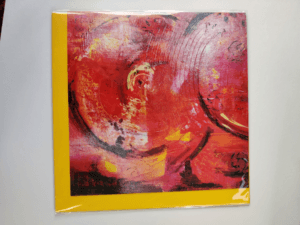
It’s worth saying that printing costs do vary between companies and can depend on where they are located (I’m not sure why but it’s true). It may be worth seeking recommendations, so if you see a good quality reproduction of an artist’s work, e.g. on a card, ask who printed it. In the example here – one of my artworks printed as a card – the name of the work, my website address, and a reorder code (plus the printers’ website address) can all be found on the back.
A Final Word of Encouragement
Seeing your artwork transformed into a beautiful print or a product someone can hold and send to a loved one is a uniquely satisfying experience. It extends the life and reach of your art beyond the studio walls. Start small – perhaps with one artwork as a greetings card or a small run of giclée prints – and build from there.
NB I do not get paid to endorse any people or brands mentioned in my blogs. If you enjoyed this post, please like, share and follow me. Sharing, liking and following raises the algorithms in my favour.
Thank you for your support.