
The Art of the Series: How to Develop a Cohesive Body of Work
You’ve chosen your Word of the Year. Your studio is decluttered, and your mind feels clearer. Now what? How do you turn that creative intention into tangible progress that builds your artistic identity? The answer, for many professional artists, lies in moving beyond single pieces and learning the art of the series.
Creating a series – a group of works connected by a theme, technique, or concept – is one of the most powerful steps you can take. It moves you from being someone who makes paintings to an artist who develops ideas. It’s the difference between a solo song and a full album.
Why Commit to a Series?
- Depth Over Breadth: A series forces you to explore an idea from multiple angles. You ask, “what else?” and “what if?”, leading to deeper understanding and more surprising results than a one-off piece ever could.
- Professional Presentation: Galleries, curators, and serious collectors look for cohesive bodies of work. A strong series demonstrates focus, commitment, and maturity in your practice. It tells a story.
- Built-In Momentum: Finishing one piece in a series naturally generates ideas for the next. It solves the “blank canvas panic” and creates a sustaining creative rhythm.
How to Start Your First Series: A Practical Framework
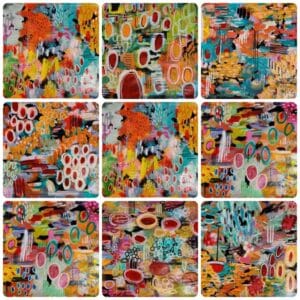
Don’t overthink it. A series can be simple and small. Start with a goal of three – five pieces or like me, here on the right, start using small panels.
- Step 1: Find Your Core Constraint. This is the unifying thread. It should be specific enough to give focus but open enough to allow exploration. Examples:
- Theme: “Shadows in my garden,” “Closed doors,” “Objects on my windowsill.”
- Formal Element: “A study in ultramarine blue,” “Squares within squares,” “Textures of rust.”
- Process: “Daily sketches of the same tree,” “Only using a palette knife,” “Monoprints from the same plate.”
- Step 2: Define Your Variables. What will change from piece to piece to keep it interesting? If your constraint is “ultramarine blue,” your variable could be the companion colour (ultramarine & ochre, ultramarine & grey). If your constraint is “my windowsill,” your variable could be the time of day or the crop/composition.
- Step 3: Create with Consistency. Use the same surface (e.g. all 30x30cm canvases), the same medium, or a consistent colour palette across all pieces. This formal consistency strengthens the visual connection and lets your core idea shine.
Navigating the Mid-Series Dip
Around piece two or three, doubt often creeps in. It might feel repetitive or you may hate the direction. This is normal! Push through.
- Pause and Look: Lay the works out together. What’s working? What’s the unexpected star?
- Introduce a Subtle Twist: In your next piece, deliberately break one of your own “rules” slightly. A new brush, a bolder value contrast.
- Trust the Process: The magic of a series often reveals itself only once all the pieces are seen as a whole.

A series is a conversation you have with yourself through your art. It’s not about creating perfect, identical clones. It’s about thoughtful variation on a theme. By committing to this practice, you build not just a portfolio, but a voice.
My approach now, is to select nine canvases of varying sizes from 100x100cm down to 20x20cm and I pick a theme which in turn relates to a colour palette. As you will know if you have been following me for a while, I am an abstract painter and at my core are colour and circles: colour to reflect a mood or feeling and circles to represent hugs.
I work on all nine canvases at the same time using the chosen colour palette and working in layers. I select a red, a blue and a yellow which forms the foundation of my collection. And then I play. Once I have all the pieces looking good, I will introduce small amounts of a different colour depending on what I feel each piece needs. Finally, I add gold leaf circles. It takes months to pull together a collection: some years I only produce one and others I can manage three.
NB I do not get paid to endorse any people or brands mentioned in my blogs. If you enjoyed this post, please like, share and follow me. Sharing, liking and following raises the algorithms in my favour.
Thank you for your support.